| Step 7 - Pattern |
|
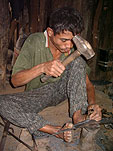
| The making of a pattern above the notch takes place in this stage and the patterns are made depending on the type of khukuri. A sharp pointed Chisel is used to make patterns and 1kg hammer for hammering. The craftsman uses his toe fingers to flip around the blade to find the right area to hammer. In some village khukuris, the brass is melted to spill inside the thin line curves made, as a part of decoration. |
 |
| Step 8 -Tamperring |
|
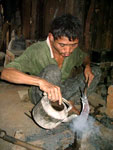
| This is another crucial stage where the blade is given extra hardness and strength. The craftsman carefully spills cold water onto the edge of fairly heated blade. It requires a great skill, as the spilling of water should be done only onto the edge and not all over the body. Otherwise it could result with cracks or at worst case could even break apart. Also the amount of water spilled should be very balance as needed and equal on both sides of the edge. This will give the edge additional strength and tolerance. |
 |
| Step 9 - Filing Blade |
|
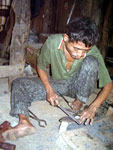
| The rough shape formed at the earlier stage is now given the actual shape. The master craftsman uses 1.5 kg hammer to bring the rough to real shape. The still is regularly heated, beaten all around the surface to achieve the required shape. This is a very time consuming stage and requires a lot of skill and year's experience. |
 |
| « Previous :: Next » |
|